
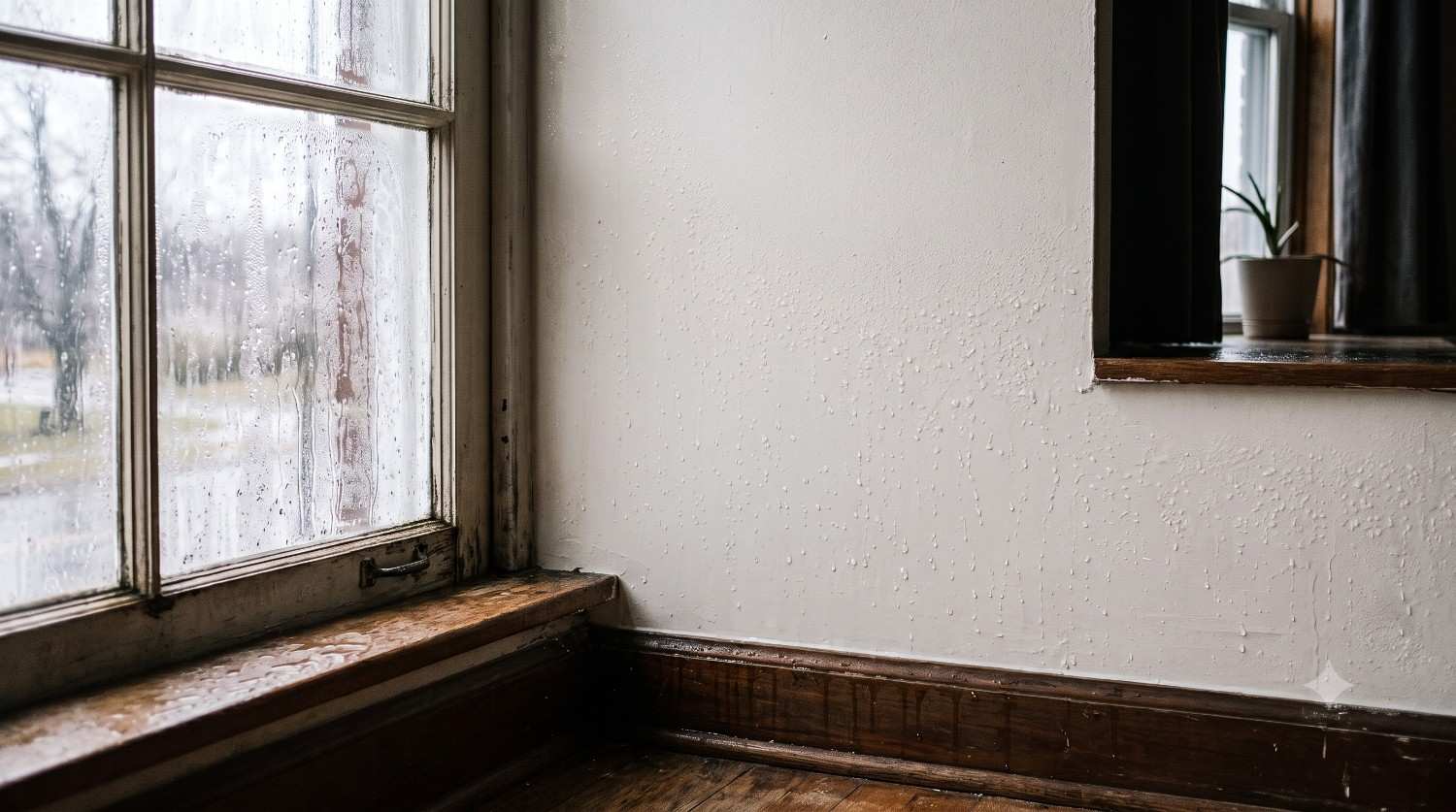
A wall that feels damp is not a paint problem. It is a signal about temperature and humidity inside the house.
Most Nashville homeowners meet it as a dark patch behind a headboard, a musty closet, or paint bubbling in one corner of a bedroom.
Repainting hides it for a season. Here is what is actually happening, and what stops it for good.
What a Sweating Wall Actually Is
The water is not coming through the wall. It is already in the air, condensing onto a surface that is colder than the air touching it.
That is the same physics as a cold drink beading up in July. The glass is not leaking, and neither is your wall.
What matters is humidity at the surface, not in the middle of the room. Building Science Corporation puts the threshold for mold growth at relative humidity above 70 percent next to the surface.
So the problem reduces to two variables: how cold the surface is, and how much moisture the air carries. How relative humidity behaves in a real house covers the underlying idea.
Why Nashville Homes Are Prone to It
Davidson County sits in the mixed-humid climate region, which means a house here faces two opposite moisture seasons every year.
In summer, humid outdoor air pushes inward while air conditioning chills the interior face of the wall. Warm wet air on one side, cold drywall on the other.
In winter, it reverses. Indoor moisture from showers, cooking, and laundry meets a wall that is cold from the outside.
Same house, two mechanisms, two different fixes.
The Common Causes
- Insulation gaps and thermal bridges. Cold spots form where exterior walls meet ceilings, at exterior corners, and above poorly insulated window headers. If your damp patch is in a corner or above a window, start here.
- A supply register aimed at a wall. Cold air blown directly across a surface can chill it below the dew point.
- An oversized air conditioner. It hits setpoint fast and shuts off, so it dehumidifies less than a correctly sized unit. The thermostat reads fine while the air stays wet.
- Duct leakage. Leaky supply ducts in the attic depressurize the house and pull humid outdoor air in through every gap. Running the fan on ON instead of AUTO compounds it, as this Middle Tennessee case study shows.
- Vinyl wallpaper and interior vapor barriers. Vapor-tight layers on the inside of an air-conditioned wall are directly linked with moldy buildings, because moisture moving inward has nowhere to dry.
- Unvented moisture sources. Bath fans ducted into attics, recirculating range hoods, and unvented gas heaters all add water to indoor air with no exit.
- A wet crawlspace. Moisture rises through the floor system into the rooms above. Crawlspace encapsulation addresses the source rather than the symptom.
- Furniture against exterior walls. The EPA lists walls behind furniture among the standard places hidden mold forms.
Warning Signs
Early:
- A wall or corner that feels cool and damp to the touch
- Condensation on window glass in the same room
- A musty smell strongest in one closet or along one wall
Further along:
- Dark speckling at corners and baseboards
- Paint blistering in a defined patch rather than across the wall
- Wallpaper lifting at seams, soft drywall, or rusting nail heads
Act immediately on standing water at the base of a wall, or mold covering more than about 10 square feet, which is the EPA’s threshold for professional cleanup.
Is It Condensation or a Leak?
Condensation is broad and diffuse, worst at corners and behind furniture, and it tracks the season.
A leak is concentrated with a defined edge, and it tracks rainfall or runs continuously if it is plumbing.
White powdery deposits on masonry mean liquid water has been moving through the wall. That is a drainage problem, not a condensation problem.
What Actually Stops It
Condensation needs a cold surface and moist air. Remove either one and it stops. Work in this order.
- Diagnose first. Thermal imaging finds the cold spots and blower door testing finds where outdoor air is getting in. Repairing the wrong cause is expensive and temporary.
- Cut the moisture at its source. Vent every bath fan, range hood, and clothes dryer to the outdoors, never into an attic or crawlspace.
- Warm the cold surface. Repair insulation gaps, seal air leaks, insulate headers and rim joists. This is what weatherization is for, and it is the step most often skipped in favor of cosmetics.
- Control humidity to a number. The EPA recommends keeping indoor relative humidity below 60 percent, ideally 30 to 50 percent. Buy a hygrometer and put it in the problem room, not the hallway.
- Clean up what grew last. Mold comes back if the moisture stays. Past the 10 square foot mark, professional remediation is the right route.
What Does Not Work
- Repainting or stain-blocking primer, which hides the stain while the moisture continues underneath
- Sealing the wall with vinyl wallpaper or vapor-tight paint, which traps moisture inside the assembly
- A portable dehumidifier on its own, which treats the air while the surface stays cold
- Turning the thermostat down, which chills surfaces further and usually makes it worse
The Bottom Line
A sweating wall is telling you that a surface is too cold, the air is too wet, or both.
Fix the surface, cut the moisture, control the humidity, and the condensation stops.
If a wall in your home keeps coming back wet, DocAir diagnoses buildings as complete systems rather than guessing at symptoms. Thermal imaging, blower door testing, and moisture metering identify the actual mechanism before any repair is proposed.
Call 615.373.2498 or request an evaluation to find out what your walls are actually doing.