
The crawl space is one of the most overlooked parts of a home, and its insulation is among the most misunderstood.
Homeowners hear conflicting advice all the time: that floor insulation is essential, that it should be ripped out because it traps moisture, or that a house is somehow substandard because its crawl space does not meet the latest energy code.
Sorting fact from sales pitch matters here because the wrong call can quietly raise energy bills and invite mold. This guide explains what building codes actually require, why one very common recommendation is simply wrong, and what a properly built crawl space really looks like.
What Building Codes Say About Crawl Space Insulation
Building codes treat the crawl space as part of a home’s thermal envelope, but how the rules apply depends heavily on whether the home is brand new or already standing.
New Construction and Gut Rehab Projects
For new homes and for many gut rehabilitation projects, codes require thermal insulation at the ceiling, wall, and floor levels for the home’s climate zone. In houses with vented crawl spaces, the floor above the crawl space is usually the surface that must be insulated, and R-19 is typically considered the minimum for that floor.
The U.S. Department of Energy publishes recommended insulation R-values by climate zone, and for crawl space applications, those targets commonly range from roughly R-19 to R-30 depending on location. Fiberglass is the most widely used insulation material, but it is far from the only option.
Spray foam, cellulose, mineral wool, and rigid foam boards, such as extruded polystyrene, are also used in crawl spaces.
Existing Homes Are a Different Story
Here is where confusion sets in. Code requirements written for new construction generally do not apply to routine maintenance, upgrades, or renovations on an existing home. Despite that, home inspectors and contractors frequently flag an older crawl space as deficient by comparing it to current code.
Which Materials Are Approved
Polyurethane spray foam is a popular choice for crawl space walls because it air-seals and insulates simultaneously, but it is not the only acceptable material. Other insulation products are approved as long as they meet the minimum R-value, often around R-10 for crawl space wall applications. The right material depends on the assembly and the moisture conditions in the space, not on which brand is marketed hardest.
The Biggest Myth: “Insulation Traps Moisture”
After the mold remediation industry expanded in the years following 1995, several termite and crawl space companies began telling homeowners to remove their floor insulation, claiming it traps moisture.
This claim is not scientifically valid, and it has cost many homeowners money for no real benefit. Crawl spaces with the insulation stripped out are a common sight, usually because a new buyer never understood the value of floor insulation and had no reason to question its removal during the purchase.
In reality, taking insulation out can make moisture problems worse rather than better.
Bare floor framing and exposed metal pipes or ducts sit below the dew point of humid summer air, which turns them into prime surfaces for condensation, and condensation is what feeds mold. The real lever for a dry crawl space is moisture control, not insulation removal.
This is consistent with the EPA’s guidance on mold and moisture control, which emphasizes that controlling moisture is key to preventing mold. When mold has already taken hold, the fix is proper mold remediation combined with correcting the moisture source, never tearing out insulation and hoping the problem solves itself.
The Right Way to Build a Closed Crawl Space
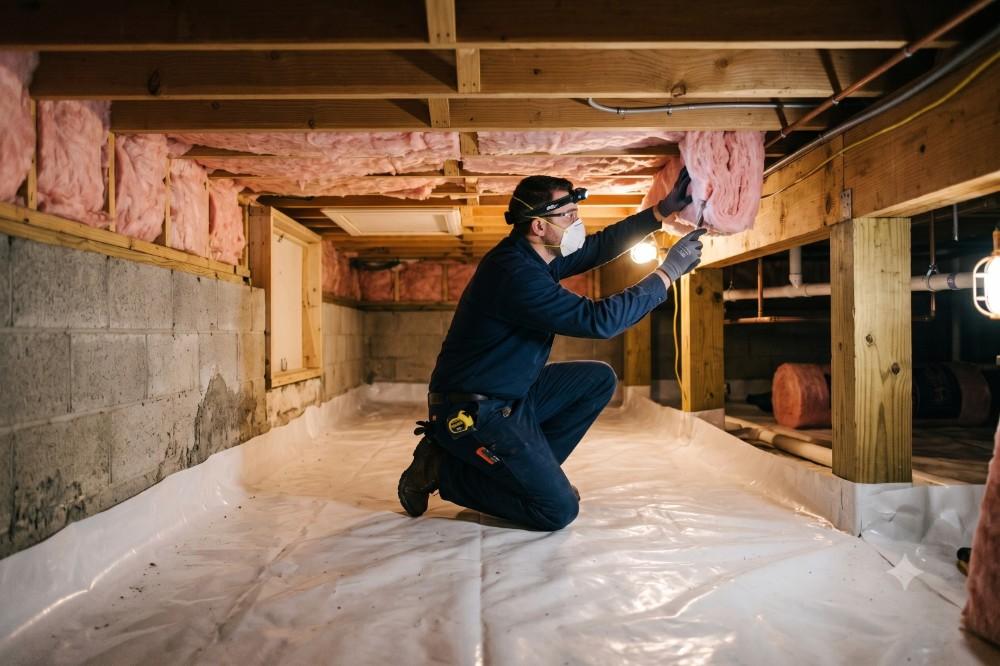
The most reliable approach, proven over decades of field experience and backed by building science research, is a sealed or closed crawl space rather than a vented one. A well-built closed crawl space generally includes four elements:
- A vapor barrier over the ground and up the walls. The floor of the crawl space and the interior foundation walls are covered with a durable plastic liner that stops soil moisture from entering the space.
- Insulation is installed over the liner, up to the band joist. Insulation is applied to the interior foundation wall, running from the height of the outside ground level up to and onto the band joist, so the thermal layer stays continuous.
- A dedicated dehumidifier with humidity monitoring. A purpose-built dehumidifier, paired with hygrometers, maintains relative humidity at a safe level and provides a continuous readout so problems are caught early.
- A radon exhaust system. Sealing a crawl space can increase radon levels inside it, so a radon exhaust system is added to manage radon levels and odors.
Done together, these steps turn a damp, vented cavity into a clean, controlled space that protects the structure above it. This is the heart of professional crawl space encapsulation, tackling energy loss, moisture, and indoor air quality simultaneously.
Do Not Overlook Radon
Radon should be given special attention in any sealed crawl space. Radon is a naturally occurring radioactive gas, and it is the second leading cause of lung cancer in the United States.
Because encapsulation reduces airflow, it can trap radon that might otherwise have escaped, which is exactly why a radon mitigation system belongs in the plan from the start rather than as an afterthought once the space is already sealed.
Why This Matters for Nashville Homeowners
Middle Tennessee is close to a textbook example of a closed crawl space.
The region sits in a mixed-humid climate zone with average humidity near 70 percent, meaning that for much of the year, the outdoor air pulled into a vented crawl space is more humid than the air already inside it. That extra moisture condenses on cool framing and feeds mold from below. Davidson County is also designated an EPA Radon Zone 1 area, the highest-risk category, so the radon question is not optional for local homes.
For Nashville and Middle Tennessee properties with crawl space foundations, properly sealing and insulating the crawl space is one of the highest-value upgrades a homeowner can make.
The Bottom Line
Crawl space insulation is not the villain it is sometimes made out to be.
Codes require it in new construction for good reason; removing it rarely fixes moisture and often makes things worse, and the proven path forward is a sealed crawl space with a vapor barrier, continuous wall insulation, dehumidification, and radon control.
When in doubt, the better question is not whether to keep the insulation, but whether the whole assembly is managing moisture and air the way it should.
If you have questions about the crawl space under your Nashville or Middle Tennessee home, DocAir can help. The Science Before Sales approach means the real moisture, insulation, and radon issues get diagnosed first, so you only invest in the work your home actually needs. Call DocAir at (615) 373-2498 or request a free evaluation to get a clear, honest assessment of your crawl space.