
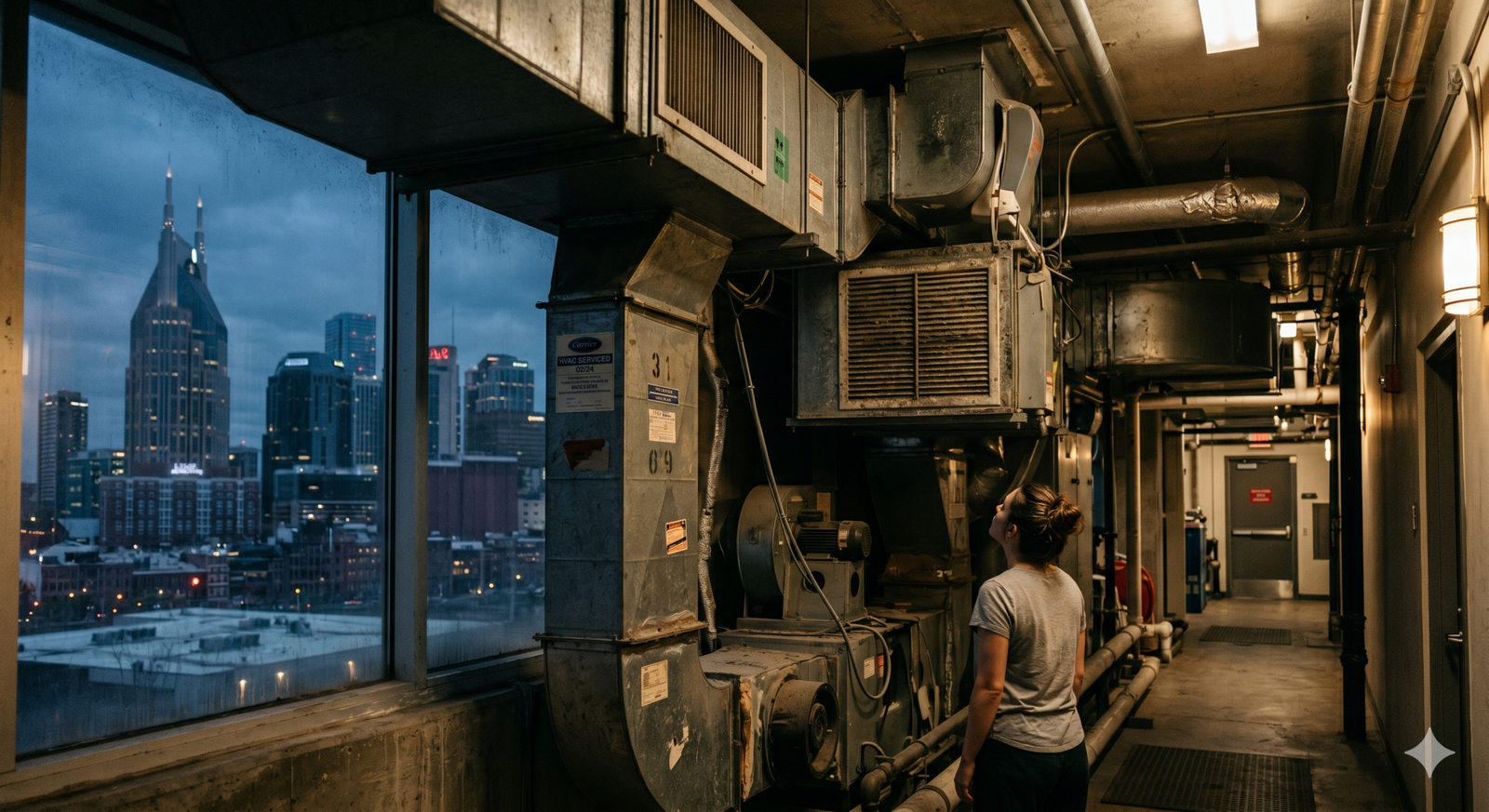
Nashville’s skyline continues to grow as thousands of new residents move into luxury high-rises from around the country.
While many expect fresher and better-controlled indoor air compared to older homes, some instead experience issues like eye irritation, headaches, or a persistent sense of “stale” air.
According to Vanderbilt University Medical Center, the quality of indoor air can be affected by a range of physical, chemical, and biological factors. The culprit is rarely the tenant or even the air conditioner.
More often, it is a ventilation philosophy borrowed from an older era of building design, one that quietly fails the moment a resident makes a small, reasonable change to their own apartment.
The “Leakage” Problem Built Into Many High-Rises
A surprising number of high-rise apartments do not deliver fresh air directly into each unit. Instead, the building pushes conditioned air into the hallways and assumes it will “leak” into the living spaces through the gaps and cracks around each front door. The corridor is pressurized, and the theory is that fresh air will naturally find its way under the door and into the home.
This is essentially natural ventilation by design, and building scientists have flagged it as fragile for years. According to the U.S. Department of Energy, the Building America program highlights that improving indoor air quality often requires providing outdoor air directly to units rather than using shared corridors, as modern approaches focus on tighter buildings with better source control, dilution, and filtration.
The weakness is structural. The system works only if every door gap, every pressure setting, and every exhaust fan in the building behaves exactly as designed, indefinitely. In the real world, residents change things, and the moment one variable moves, the whole airflow path can reverse.
When Your Bathroom Starts to “Inhale”
Consider a real failure pattern seen in a Nashville high-rise. According to the CDC, following current ventilation codes is important for ensuring proper airflow and can help prevent issues like the subtle but dangerous reversal in apartment air movement that may contribute to symptoms such as eye and lung irritation.
To block odors drifting in from a nearby trash chute, she had installed a baffle, a simple seal, under her front door. It was a sensible fix for a real nuisance. But in a hallway-leakage building, that gap under the door was not a flaw. It was her apartment’s primary air intake. By sealing it, she unknowingly cut off her only steady source of fresh air.
Air, though, has to come from somewhere.
According to Steven Winter Associates, high-rise multifamily buildings can experience strong wind and stack effects that lead to pressure imbalances between units.
When the hallway path was closed, these imbalances caused her apartment to pull air backward through the bathroom exhaust vent, drawing in stale air from the shared exhaust shaft connected to other units instead of venting moisture and odors outside.
This backdrafting effect is well documented in multifamily buildings, where a sealed or depressurized unit will pull air from whatever opening it can find, including ducts shared with neighbors.
The measured results were striking. Carbon dioxide in the bathroom ran about three times higher than outdoor air, and volatile organic compound (VOC) levels were spiking.
For context, outdoor air sits near 400 parts per million of CO2, and ventilation guidance summarized in the ASHRAE position document on indoor carbon dioxide treats sustained indoor levels well above that as a clear signal of inadequate fresh-air delivery, the kind of environment linked to drowsiness, headaches, and reduced concentration.
Why This Methodology Is Fundamentally Flawed
The case above is not a freak accident. It exposes the core weakness of the hallway-leakage model: it is an inconsistent, uncontrolled way to supply oxygenated air and dilute the contaminants people generate just by living, cooking, and breathing.
When the intended air path is blocked, even by something as minor as a draft stopper, a new welcome mat, or upgraded weatherstripping, the home does not simply stop ventilating.
It starts breathing from parts unknown. According to the Metro Nashville Codes Administration, local building standards follow the 2024 International Mechanical Code, which sets requirements to prevent problems like shared or contaminated exhaust shafts in apartment buildings that could circulate cooking odors, cleaning chemicals, and stale air between units.
This is especially important because indoor air quality directly affects the health and comfort of residents. The EPA notes that indoor air can carry pollutant levels several times higher than outdoor air, and that most people spend the vast majority of their time inside.
A ventilation system that only functions properly under ideal conditions is likely to be unreliable in everyday situations.
According to Metro Nashville’s Codes Administration, all new high-rises in the city are required to comply with the 2024 International Mechanical Code and related building standards, yet practical challenges can still affect whether these systems perform as intended. Lighter than older ones.
Tight construction is excellent for energy efficiency, but it also means a unit has almost no incidental “leakage” to fall back on when the designed air path fails. In a drafty older building, a blocked door gap barely registers. In a sealed modern high-rise, it can be the difference between fresh air and recirculated exhaust.
Add in the realities of downtown living, trash chutes, shared corridors, neighbors with very different cooking and lifestyle habits, and the incentives for residents to seal their doors only grow.
Many of the people moving into these buildings are also new to high-rise living and have no reason to suspect that the annoying gap under their door is doing a critical job.
The result is a steady stream of “mystery” irritation and stale-air complaints across otherwise brand-new luxury units.
How to Diagnose and Fix It the Right Way
Fixing this problem means addressing the physics, not just masking the symptoms with an air purifier or a scented diffuser.
A proper diagnosis starts by mapping how air actually moves through the unit, which is where a structured indoor air quality and airflow investigation earns its keep.
Smoke testing, pressure readings, and CO2 and VOC measurements reveal whether a home is being supplied with fresh air or quietly pulling it from the wrong place.
Active Exhaust to Stop Backflow
The most reliable fix is to take control of the exhaust. Installing a continuous, low-volume fan ensures the bathroom vent only ever moves air out of the home, never back in.
This prevents the backdraft entirely and removes moisture and odors the way the system was always supposed to.
Pairing controlled exhaust with proper whole-home air filtration further cleans the air that does enter, rather than leaving it to chance.
Path Management and Building Pressure
The second half is education and balance. Residents in a hallway-leakage building need to understand that the gap under the front door is effectively their lung, annoying as it may be for noise or smells.
Sealing it without replacing the air source is what triggers the failure. On the building side, validating corridor and unit pressures, the kind of work done in an air barrier audit, confirms whether the tower is actually holding the pressure relationships its design depends on.
Where it is not, targeted air-sealing and building-wide testing and verification can restore the intended airflow.
The Bottom Line for High-Rise Residents
Persistent irritation, headaches, or that heavy “stale” feeling in a brand-new apartment is not something residents simply have to live with, and it is rarely their fault. It is usually the predictable result of a ventilation methodology that assumes a building will behave perfectly forever. Once you understand that your home has to get its air from somewhere, the fix becomes clear: make sure that somewhere is clean outdoor air, not a shared exhaust shaft.
If you have moved into a Nashville high-rise and noticed ongoing irritation or stale air, the building’s design may be to blame, and it can be measured and corrected.
DocAir maps your airflow with building-science diagnostics and engineers a permanent solution for a healthier indoor environment. Call 615.373.2498 or request an evaluation online to find out exactly where your air is coming from.