
In the world of home inspections, few phrases trigger a stop-sale panic faster than one short line buried in the report: recommend evaluation by a structural engineer. To a buyer or a real estate professional reading it cold, that sentence can feel like a diagnosis of impending collapse. The financing wobbles, the timeline stalls, and a deal that was sailing along suddenly hits the rocks. The truth is usually far less dramatic, and understanding why can save a transaction that never needed saving.
What That Recommendation Actually Means
Many of the issues that earn this flag are less like a structural emergency and more like a vintage car without modern airbags. It still drives perfectly well. It simply was not built to today’s standards. A home inspector noting a deviation is doing exactly what the job calls for, no more and no less. Under the InterNACHI Standards of Practice, a home inspection is a visual examination based on the conditions observed on the day of the inspection, and explicitly not a prediction of future conditions.
Those same standards also make clear that inspectors do not perform engineering services and do not offer an opinion on the adequacy of a structural system. So when a report says to bring in an engineer, it is often a routine, liability-conscious handoff rather than a verdict. Industry guidance from InterNACHI on whether to recommend a contractor or an engineer notes that referring the engineer is the safe move for the inspector, because the engineer assumes the liability. That is good practice. It is not a prophecy of disaster.
The Proof Is in the Performance
Older homes in this region are often supported by cedar posts or stone piers. These systems have been doing their job for 80, 90, even 100 years. That track record is not a footnote. It is empirical evidence. If a building has stood for decades with no sign of displacement, sagging, or shifting, the support system is demonstrably working.
When an inspector flags a wood-to-subfloor contact or a non-standard pier, they are not necessarily predicting a catastrophe. They are noting a deviation from modern textbook design. Those are very different statements. A non-standard look is not the same as active movement, and the distinction is exactly what a calm, evidence-based evaluation is meant to sort out.
This is where a measured second opinion earns its keep. Tools like infrared thermal imaging and moisture investigation can confirm whether there is a real, active problem behind a cosmetic deviation, or whether the system is simply old and unfamiliar to a modern eye.
Buttressing vs. Re-Engineering
Too often, the default response to a less-than-perfect support is an expensive engineering consult followed by a recommendation for a total overhaul. But there is a practical middle ground that gets overlooked: buttressing.
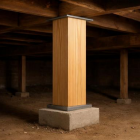
Reinforcing an existing system, such as replacing an edge-mounted 2×8 with a vertical solid post and steel plates, addresses the inspector’s concern directly. It improves the performance of the floor without the wholesale replacement of a system that has already proven its worth. The concern on the report gets resolved, the buyer gets peace of mind, and nobody pays to re-engineer something that was already carrying the load just fine.
Sorting a targeted fix from a full overhaul is also where an independent advocate matters. Having someone in your corner whose only job is acting as your independent adviser, accountable to you rather than to the sale, keeps the response proportional to the actual evidence.
The Practicality Test
Not everything in a home is a cut-and-dried issue. If a modification would not fundamentally change the building’s performance, because the building was already performing well, the honest question is: why are we doing it at all? Before a structural recommendation derails a deal, run it through three quick questions.
- History. Has the system worked for decades without trouble?
- Evidence. Is there actual movement, or just a non-standard look?
- Targeted fixes. Can the system be buttressed and improved for a few hundred dollars rather than re-engineered for thousands?
If the answers point to a long history, no active movement, and a fixable detail, the right move is rarely a teardown.
Confirming the difference between a cosmetic deviation and a genuine defect usually comes down to checking for the moisture and movement that actually drive structural decline. Catching moisture intrusion before it undermines a structure is far more useful than reacting to an unfamiliar but stable support.
The Takeaway for Professionals
Let’s stop treating every minor support issue like a structural cancer and start looking at the empirical evidence right in front of us. The first and most important question is the simplest one: is it working? A decades-old system with no signs of distress has already answered that question, and a calm, evidence-based evaluation is usually all it takes to keep a sound deal on track.
If a recommendation for further evaluation has a deal in limbo, DocAir can give you a straight, engineering-based read on what the report actually means and whether a targeted fix or a full overhaul is warranted. As Nashville’s building science experts, founded by a Certified Industrial Hygienist and professional engineer, we deliver data-driven answers, not worst-case guesses. Call 615.373.2498 or request an evaluation here, and get the facts before the panic button gets pushed.