
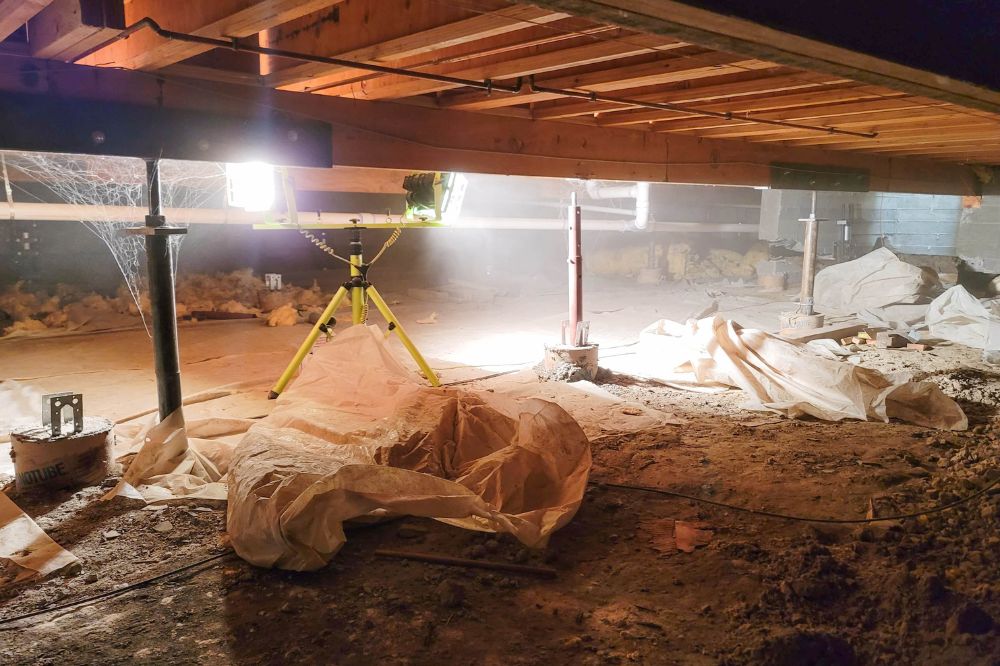
A customer recently requested a mold spore trap test of the air in the crawlspace to verify the effectiveness of previous crawlspace encapsulation and dehumidifier installation. This sampling method relies on a vacuum pump to pull a known volume of air across a sticky collection plate. The mold spores captured on the plate are counted under a microscope and the results are presented as spores per cubic meter. The results showed 49,000 spores per cubic meter. What is the explanation of such a high number? Does it indicate a failure of the system installation?
Aspergillus and Penicillium are common molds found in outdoor and indoor environments, particularly in areas conducive to mold growth, such as middle Tennessee crawlspaces during hot summer months when humidity levels rise. Over time, mold spores will settle and accumulate on surfaces within the crawlspace, leading to elevated concentrations in the ambient dust.
It’s important to note that the very process of collecting spore trap samples can impact the results significantly. Aspergillus and Penicillium spores are too small to be seen by the human eye. Once airborne, they can float for hours until they ultimately settle out by gravity or electrostatic attraction. When sampling is conducted, even minor disturbances—like crawling and moving around in the crawlspace—can create a cloud of mold spores that can cause the measured levels to spike.
While mold spore testing is a valuable tool for assessing indoor air quality in the living spaces of the home, it has its limitations in other applications. Crawlspace mold spore trap testing is highly susceptible to physical disturbances during sampling. Therefore, the results should not be viewed as definitive indicator of air quality in the in the living spaces of the home.
Tape Lift Testing
Another common evaluation tool used by home inspectors, is the “tape lift” where cellophane tape is applied to a floor joist or other surface. The sample is submitted to the lab for microscopic analysis. We see reports where the results of this type of testing are extrapolated to characterize the moldiness of an entire home. This is pseudoscience and not a logical way to evaluate indoor air quality. Imagine if you concluded that your home was contaminated based on the discovery of a small amount of e. Coli on a kitchen countertop.
Consumers should not rely on tape lift testing for any purpose other than to verify whether surface residue indeed contains mold. Although, there is little need for this type of testing by IAQ professionals; however, it is commonly done to justify extensive remediation work with the assumption that the very presence of mold poses a health risk.
DocAir Philosophy
Converting a crawlspace into a Clean Room is an expensive and impractical way to achieve good indoor air quality. In fact, DocAir believes that the crawlspace air should be isolated, and separate, from the breathing air in the home.
DocAir focus develops methods to optimize the indoor environment using a variety of assessment methods including visual reconnaissance, thermal imaging, blower door (pressure) testing, moisture evaluations, and VOC and particulate testing, These approaches provide our diagnosticians with a comprehensive understanding of building dynamics which are the key creating a healthy indoor environment.
Barry C. Westbrook,
President, DocAir Building Solutions