
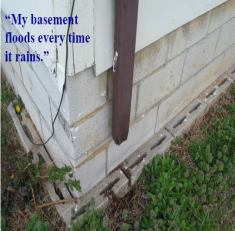
Storm water infiltration can destroy a building over time and turn an otherwise sustainable design into an unsustainable one. We receive hundreds of calls each year from homeowners and real estate professionals complaining about water infiltration, and in almost every case the caller has no idea what is causing it. The best guess is usually that some kind of wet weather spring has suddenly appeared out of nowhere to wreak havoc on the hapless homeowner. Is this really an unforeseen calamity with nothing to do with an otherwise perfectly designed drainage system? Not likely.
Wet weather springs are not the problem. In most residential subdivisions, there is no integrated drainage design for the individual homes, so bad things are bound to happen: wet basements and crawlspaces, mold, and dry rot. Sometimes the problems show up immediately, but more often the homeowner begins to notice the symptoms weeks, months, or even years after construction. One thing is for sure: these drainage deficiencies are not accidents. They are predictable outcomes of bad design.
Once the homeowner discovers the signs of water infiltration, some of the most preposterous solutions get offered, and actually implemented. We categorize them as follows.
Build a Moat
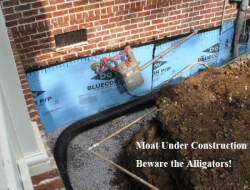 If you think of your home as your castle, you can dig a deep trench next to the foundation, install a perforated plastic pipe, and fill the trench with gravel. This will invite all the storm water in the neighborhood to come right up to your foundation wall. You have just built a moat for your castle.
You might say, “No problem, I have the pipe in the trench to drain the water away once it reaches my moat.” Two things: the pipe will deteriorate and fill with debris in short order, and for the water to drain at all, there has to be some standing water to drive the flow. (Remember Hydraulics 101?)
So what you have really done is pay someone thousands of dollars to destroy your landscaping and make the problem permanent. Believe it or not, there is a huge industry installing these systems all over the country.
Invite the Water Into Your Home
Maybe even worse than the moat idea is installing a trench inside the foundation wall to collect the infiltration and pump it away. We call this the NeverDry System. (Get it?)
There are a number of problems with this approach, but probably the most offensive from a building science perspective is the constant erosion around the foundation as we encourage perched ground water to flow into the building. It also creates a direct conduit for the infiltration of radon and more moisture. The sump running around the perimeter of the basement becomes a haven for mold, bacteria, insects, and other vermin.
So What Is the Right Way to Fix It?
The obvious answer is to design the storm water management system correctly and integrate it into the construction of the building. From our experience, doing this would eliminate 90 percent of homeowner complaints and save untold millions of dollars in often counterproductive repairs.
There are four basics that, if followed, will practically guarantee a water-proof home:
- Install the proper size gutters and the appropriate size and number of downspouts.
- Keep the gutters free of debris.
- Get the water from the downspouts away from the foundation, and keep it away.
- Install clay or an equivalent water-retardant material next to the foundation.
And if there is a regional flow of water toward the building, install a curtain drain well away from the foundation so that water never reaches the building wall.
Finally, it is worth stressing that substandard drainage is not just a residential issue. Some of the same misguided principles are at work in commercial construction as well.
If we want to create sustainable structures, we have to remember that old line about the definition of insanity. Regardless of what anyone says, whatever we are doing today is not working very well. The key to overcoming bad habits is to forget how we have done things in the past and evaluate what actually makes sense. The payoff comes in longer-lasting, healthier buildings, and fewer headaches from trying to repair problems that never should have existed.
Dealing with water infiltration, a wet crawlspace, or moisture you cannot explain? DocAir diagnoses the root cause instead of treating the symptom. Request an evaluation or call us at 615.373.2498.
Barry Westbrook, DocAir LLC