
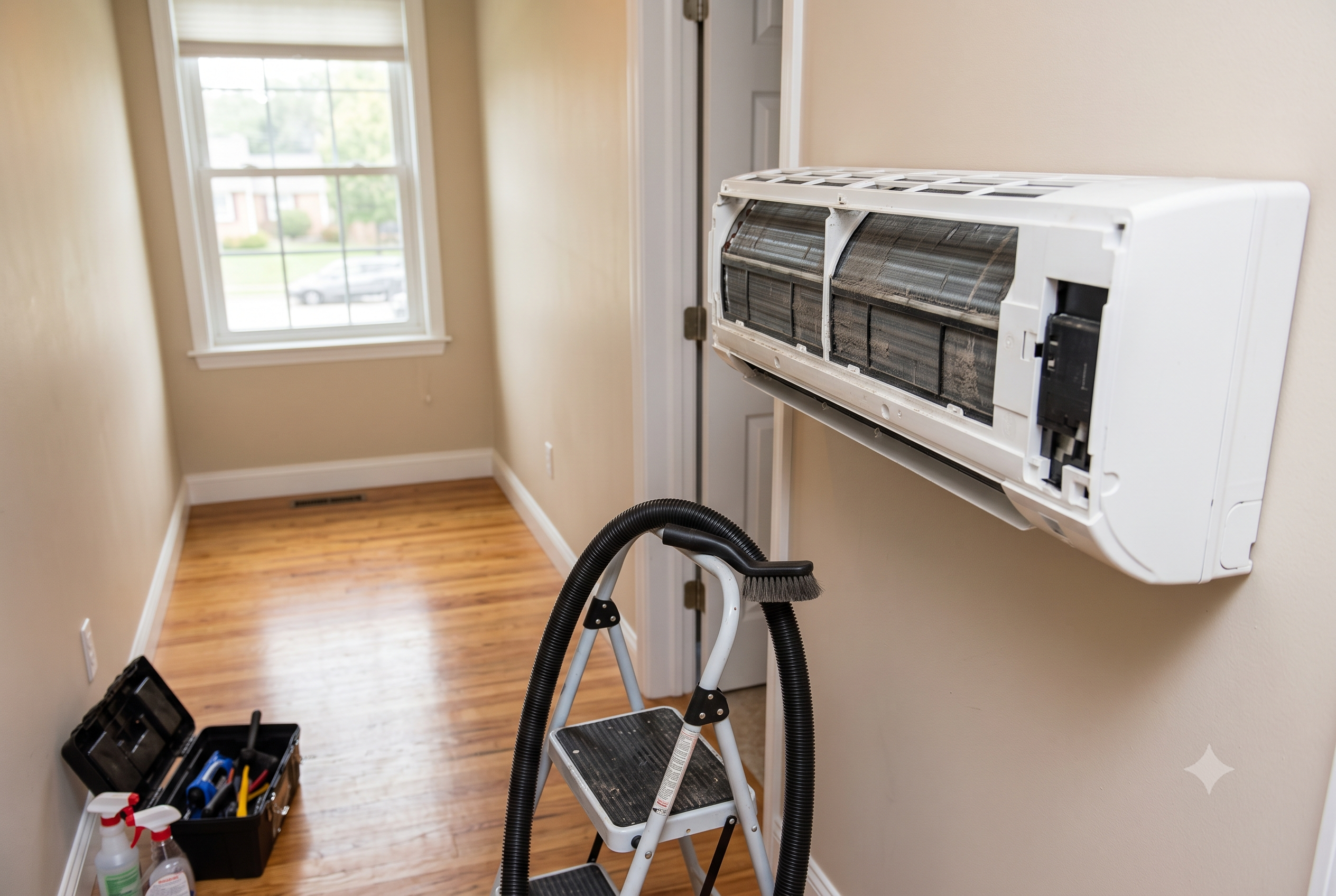
Intermittent musty odors upstairs are one of the most common indoor air complaints we hear. They almost always trace back to the same place.
This case walks through a recent DocAir field investigation. From the first complaint to the root cause and the fix, so you can spot the same pattern at home.
The Situation
A homeowner reported a stale, musty smell in the upstairs living areas. It showed up in a space that was not used every day.
The odor was intermittent. It would roll out of the vents for a minute or two when the system kicked on, then fade.
Nothing looked visibly wrong, and the air smelled fine most of the time. That is exactly what makes this problem easy to ignore and hard to pin down.
The Investigation
Rather than mask the smell, the goal was to find its source. An odor that appears at startup, then disappears, points inside the air handler, not the ductwork or the room.
The likely culprit was microbial stagnation on the cooling coil. Here is the mechanism.
The evaporator coil, the cold coil inside the indoor unit, pulls heat and moisture out of the air. As household air passes over it, water condenses and drips into a pan directly below.
That constant dampness meets the fine layer of dust every home carries. Together they create an ideal surface for surface bacteria and mold to settle and multiply.
HVAC technicians call the result “dirty sock syndrome.” When the system shuts off, the growth sits there.
When it starts back up, the first rush of air picks up those organic odors and distributes them through the upstairs.
This matters because indoor air is where we spend nearly all of our time. The EPA notes that Americans spend roughly 90 percent of their time indoors, where some pollutants run two to five times higher than outdoors.
Why the Upstairs Was Worst
The location was not a coincidence. Because the space was used infrequently, the system there ran in short bursts.
It reached the set temperature quickly, shut off, and never ran long enough to dry the coil and drain pan completely.
Moisture that would normally evaporate during a longer run lingered between cycles. Standing moisture is exactly what surface bacteria need to keep growing.
The short cycling that saved a little energy in an empty room was quietly feeding the odor.
The Ventilation Question
A reasonable assumption is that more fresh air would fix the smell. Fresh air does help, but it has limits.
Every home has ventilation of some kind. Natural ventilation is the unplanned air entering through gaps and cracks in the building envelope.
In homes built over a crawlspace, that space is often a major path for incoming air. Sealing and conditioning it through crawl space encapsulation gives far more control over what comes in.
A predictable, filtered source of fresh air through HEPA air filtration will dilute and purge odors already floating around.
What ventilation will not do is remove the biofilm on the coil. Diluting an odor is not the same as removing its source.
The EPA also recommends keeping indoor relative humidity between 30 and 50 percent to discourage growth. But the coil itself still has to be cleaned and kept dry.
The Fix
The resolution combined a one-time reset with a few ongoing operational changes.
- Deep coil and drain-pan cleaning. An antimicrobial cleaning removed the buildup producing the scent and reset the system. Heavier growth calls for professional remediation.
- Dry the coil after every cycle. Running the fan briefly after cooling stops, or using a circulate mode, finishes drying the coil so moisture never goes stagnant.
- Do not shut the room off entirely. A dehumidify or high-temperature away setting around 78 to 80 degrees keeps the system running just enough to pull moisture out of the air.
- UV-C germicidal lights. Installed near the coil, they suppress bacteria and mold at the source, a strong long-term defense.
- Monitor with data, not guesswork. Temperature and humidity monitors, the same approach used in indoor air quality testing, showed how the space actually performed hour to hour.
Key Learnings
A few takeaways carry over to almost any home with the same complaint.
- The smell is a symptom, not the disease. An odor at startup points to moisture and microbial growth on the coil, not “bad air” that needs covering up. Treat the source.
- Rarely used rooms are the highest risk. Short cycling leaves coils damp between runs. The spaces you use least tend to develop the odor first.
- Fresh air dilutes, it does not clean. Ventilation helps overall air quality, but it cannot remove biofilm already growing inside the system.
- Never fully shut a system off in a humid climate. Minimal runtime to manage moisture beats an off system that lets condensation build unchecked.
- Measure before you adjust. Monitoring turns a guessing game into a solvable problem, and confirms whether a fix actually held.
When to Bring in a Professional
A single coil cleaning resolves many cases. A deeper look is warranted if the smell returns within a season, or if there is visible mold near the vents or air handler.
The same is true if humidity stays high regardless of the setting, or if several rooms are affected at once.
Those patterns suggest the root cause sits deeper, in moisture entering the home, in duct issues, or in a system that is short cycling.
If a recurring musty odor keeps showing up in your Nashville area home, DocAir can measure exactly what is happening inside your system and fix the underlying cause. Call 615.373.2498 or request an evaluation to get started.